
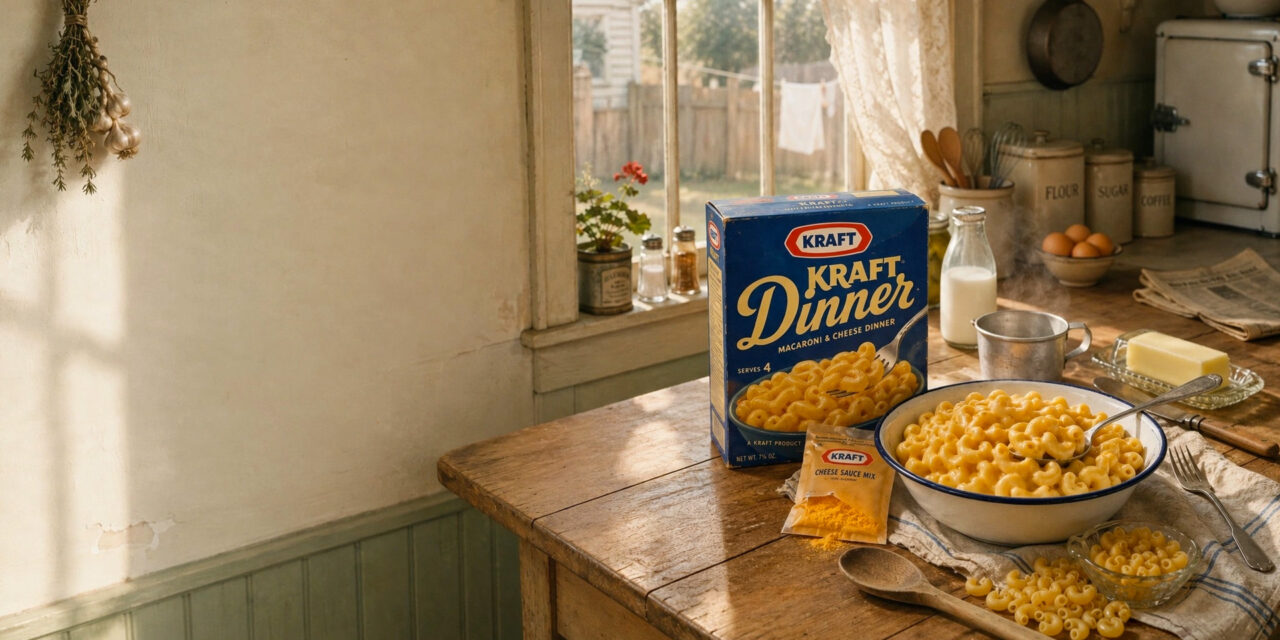
Few foods inspire quite the same nostalgic reaction in Canada as Kraft Dinner. Whether it was a childhood lunch, a late-night university meal, a quick dinner after a long day, or something you still occasionally crave for no particular reason, that familiar blue box has been part of Canadian kitchens for generations.
But how did a simple combination of macaroni and powdered cheese become such an enduring cultural phenomenon? The story actually begins during the Great Depression, with a salesman, a rubber band, and a surprisingly clever idea.
An idea born during the Great Depression
In the 1930s, feeding a family wasn’t always easy. The Great Depression had left millions of people struggling financially, and affordable, filling meals were in high demand.
Enter Grant Leslie, a salesman working in St. Louis, Missouri. According to the commonly told story, Leslie came up with a clever way to sell more pasta: he attached packets of grated processed cheese to boxes of macaroni using rubber bands. Rather than selling two separate products, he was effectively offering customers the ingredients for an inexpensive meal in one convenient package.
The idea caught the attention of the Kraft cheese company, which recognized the potential of combining its processed cheese with pasta into a ready-to-prepare dinner.
In 1937, Kraft introduced its boxed macaroni-and-cheese dinner, marketed as Kraft Dinner. The promise was simple and compelling: a meal for four people for just 19 cents, prepared in approximately nine minutes.
For families trying to stretch their budgets, that was a pretty attractive proposition.
Eight million boxes in its first year
The product didn’t take long to catch on. In its first year, Kraft reportedly sold approximately eight million boxes.
And it wasn’t difficult to understand why.
The product was inexpensive, easy to prepare, required no refrigeration, and had a long shelf life. At a time when many households didn’t have modern refrigerators, a product that could sit in the pantry for months was particularly practical.
It wasn’t fancy food. It wasn’t trying to be.
It was an affordable, convenient dinner that could feed an entire family without requiring a complicated recipe, expensive ingredients, or much time in the kitchen.
And that combination of affordability and convenience would prove incredibly important in the years that followed.
World War II helped make it a household staple
When World War II began, food rationing changed the way families shopped and cooked. Dairy products and other ingredients became more difficult to obtain, and households increasingly relied on affordable, practical alternatives.
Kraft Dinner fit perfectly into the circumstances.
Its shelf stability, low cost and ability to provide a filling meal made it an appealing choice. During the war, Kraft Dinner reportedly became particularly popular because two boxes could be purchased using a single ration coupon in the United States.
The product wasn’t just convenient anymore. It was perfectly suited to the economic and practical realities of the era.
And as the years passed, it became something much more than a Depression-era invention.
How Kraft Dinner became distinctly Canadian
Here’s where the story gets particularly interesting for Canadians.
In the United States, the product eventually became known primarily as Kraft Macaroni & Cheese or Kraft Mac & Cheese. In Canada, however, the original name, Kraft Dinner, stuck.
Canadians also embraced the abbreviation KD. According to research into Canadian English, the nickname was reportedly coined by consumers themselves, rather than by Kraft’s marketing department. The company eventually adopted it as part of its branding.
Over time, Kraft Dinner became so deeply embedded in Canadian culture that the name itself is often used to describe boxed macaroni and cheese in general, regardless of brand.
That’s quite an achievement for a product originally conceived as a way to sell pasta and cheese together.
Kraft Dinner is also frequently associated with university students, quick meals, childhood memories and those moments when you simply don’t feel like cooking anything complicated. It’s a food that has managed to remain familiar across generations, even as tastes, lifestyles and grocery shelves have changed dramatically.
More than just macaroni and cheese
Of course, Kraft Dinner isn’t exactly a culinary masterpiece. It’s not the sort of meal you’d expect to find in a fine dining restaurant, and that’s probably part of its charm.
Over the years, people have developed countless ways to customize it. Some add hot dogs. Others add tuna, bacon, vegetables, extra cheese, spices or even ketchup. There are probably as many personal Kraft Dinner recipes as there are Canadian households.
But the original appeal remains remarkably unchanged: pasta, cheese, convenience and affordability.
It’s a product that was designed to solve a very practical problem and ended up becoming a cultural institution.
A little blue box with a big history
Nearly nine decades after its introduction, Kraft Dinner remains one of those products that almost everyone recognizes.
Its history is a reminder that some of the most successful products aren’t necessarily born from complicated inventions or extravagant ideas. Sometimes, they’re the result of recognizing what people need at a particular moment in history and finding a simple way to deliver it.
A salesman with a rubber band, a packet of cheese and a box of macaroni helped set the stage for one of Canada’s most enduring food traditions.
And the next time you open that familiar blue box, you might just appreciate that your quick dinner has a little more history behind it than you thought.











Leave a Reply